Sunday, October 2, 2011

Fuzzy Visitor

Fingered Dagger Moth Caterpillar
(Acronicta dactylina)

(5th instar larva)

I found this little guy walking through my rock garden.
Listed as uncommon but widely spread,
the Dagger Finger Moth,
as pictured below,

(Janice Stiefel/bugguide.com)
is found in deciduous and mixed wood forests 
in all of the U.S. and S. Canada.

Larva feed on willow, alder, birch, poplar and hawthorn,
overwintering as a pupa in leaves or debris.
Larvae are present from July to October.


Friday, September 2, 2011

A Quiet River Paddle

Framboise River
Cape Breton

I don't know if the name of the river really is Framboise River, 
but it is a river and it is in Framboise.
Originally, plans were to paddle the mudflats a few miles up the road 
to observe migrating shore birds,
but the flats were fogged in and it was cold!

However, a few miles down the road, 
the sun was shining, the air was hot,
and the river beckoned.


Eastern Forktail, (Ischmura verticalis)


Horned Bladderwort, (Utricularia cornuta)


 A lone white water lily.


 I don't know my water bugs!


Juncus canadensis


Variable Dancer, (Argia fumipennis),
hitching a ride.


Not a clue, but oh, so pretty!


All visiting paddlers 'otter' be entertained!
There were four and they were SO cute!


I'm still toiling over my hawk identification skills.
Judging from all the other photos I took,
I believe this to be a juvenile Red-tailed.


Sparganiium spp, perhaps emersum, with Northern Bluet (Enallagma cyathigerum).


And last, but not least, a Greater Yellowlegs.


Tuesday, August 2, 2011

Simple Abundance

Gooseberry Cove
Cape Breton, NS

Perhaps one of the most beautiful spots
along the Cape Breton coast,
Gooseberry Cove took my breath away
the first time I visited the area.
On that particular day, the angry sea
sent waves crashing among the rocks.


But today's visit was relatively calm.


This is 'Crown Land', owned by the government,
and much to my delight, Nova Scotia is considering
making Gooseberry Cove 
a protected wilderness area.


An hour and a half drive, and well worth every mile.


Approximately 30% of the land in Nova Scotia
is 'Crown Land', and the government has proposed
to set aside 12% as protected areas by 2015.


If I'm reading the information correctly, 
they are not adding an additional 12%, but are
combining new properties to bring 
the total of protected wilderness areas
up to the 12% mark.


Black Guillemots were everwhere!
If only I could include the delicious smell of the sea air,
almost acrid at low tide. 


The only way I was going to capture
this Chalk-fronted Corporal (Ladona julia
was to catch him in mid-air!


This little toad was there all day.


One of my most favorite bog plants to photograph,
the Cloudberry (Rubus chamaemorus
is considered a delicacy!  
Locations are often kept secret!


The carnivorous Pitcher Plant (Sarracenia purpurea).


Blue Flag (Iris versicolor)

I applaud Nova Scotia's efforts to preserve the wilderness.
Progress is encroaching rapidly.
I have the opportunity to see a lot.
and it isn't always pretty.
Lots of ATV's damaging the bogs
and dunes, illegally, of course.
Forested areas are just as abused.

Simple Abundance?
Only if they become more conscientious about managing
these protected areas. 

That's


Monday, July 18, 2011

Silly Willet

Eastern Willet
(Catoptrophorus semipalmatus)

Upon my return to Cape Breton late this spring,
(spring was late, too!!),
The Ranger surprised me with 3 completed 
and installed Tree Swallow nesting boxes.


Much to my delight, the Tree Swallows returned the very next day
and after much 'to-do', inhabited all 3 boxes.

What does that have to do with silly Willets, you ask?
Well, they were under the impression that the Tree Swallow houses
were installed for their benefit!


It gives them a perfect vantage point for
keeping an eye on their territory, my 2.5 acre wet meadow.
From spring until mid-July, my airspace is filled with

On this particular morning, there were two willets
 really making a racket,
and they were everywhere....


These two birds filled the sky.  
You could have easily thought there were 20!
The Willet is often described as a large, chunky, shore bird with drab brown plumage.
That is until it takes of in flight!!


They were on the house top.


On the shed roof.


On the street lamp and.
even on the road.


This went on all day long.  I couldn't figure out what was going on.

Until around 2:00 when I was taking clothes in from the line.


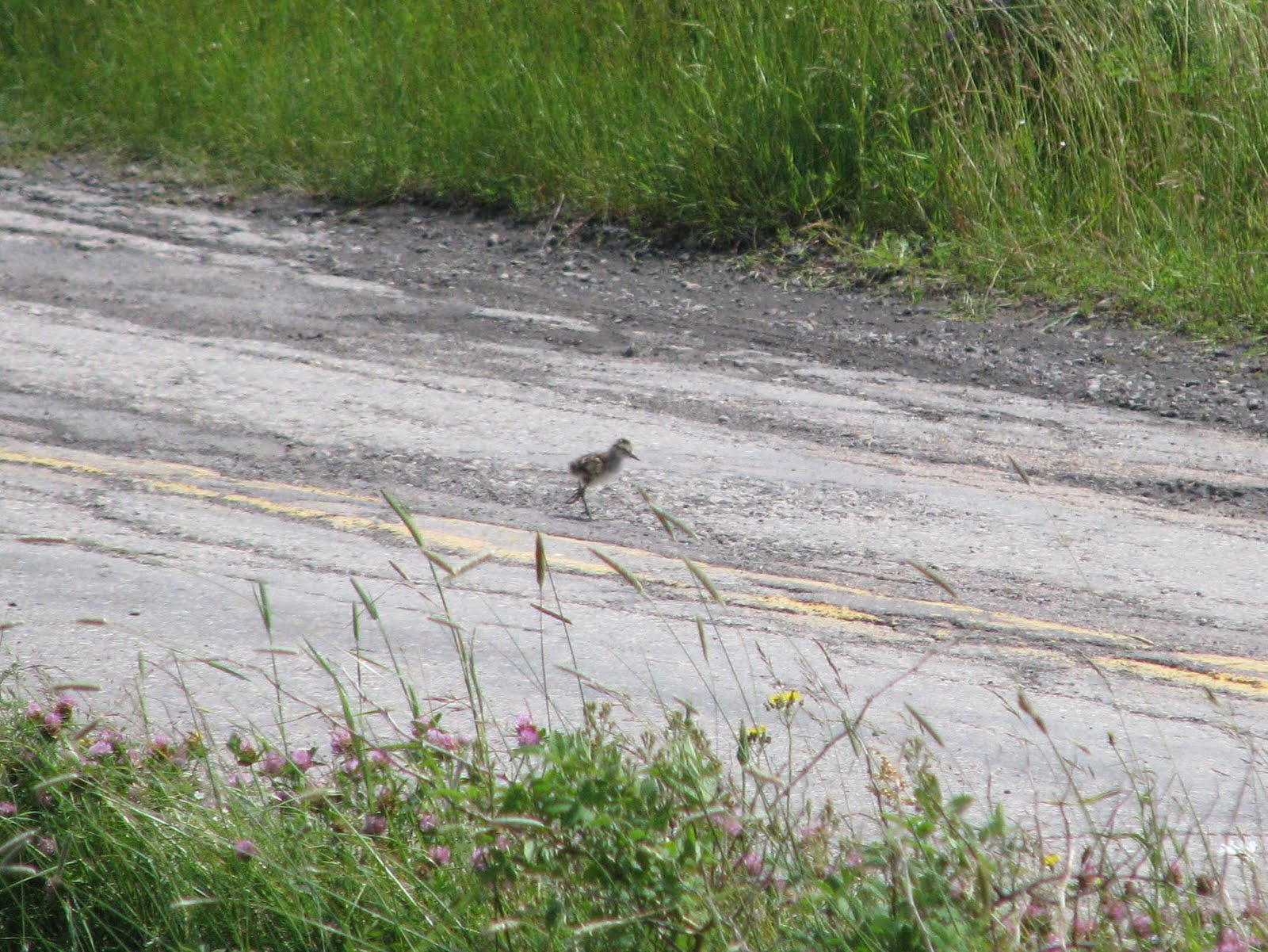
Yep!  Three baby willets finally emerged from the grass 
and went across the road to the shore, one at a time.
A fourth wasn't too far behind. 
 I grabbed my camera and binoculars 
and sat on the shore,waiting patiently. 
 Almost one hour later, they worked their way through more grass,
and popped out onto the shore, 
where I lost them because they blended in so well.
It took them all day, but those babies made it 
across the 2.5 acres of meadow,
and across the ditch by the side of the road.


I was so impressed with the parent birds.  
They stuck to those babies like glue.
An eagle came down 4 times, 
and they fought him off each time.


They stuck around for a day and a half, 
then worked their way down the shore.
Today I observed them about 1/2 mile away
 at a friend's house.
I will miss them.

The female will eventually take off 
and leave the rest of the parenting to the male.


Reminder:  Tuesday is the last day to enter for a chance to win
a copy of Avian Architecture over at KaHolly.


Wednesday, July 13, 2011

Avian Architecture: Book Review and Give-away


Avian Architecture
How Birds Design, Engineer and Build
by Peter Goodfellow


When Peter Goodfellow was growing up in England, he must have been one of those affectionately annoying little boys that asked a lot of questions, all the time. “How does this work?”, “Why does that happen?”, Where do you imagine that goes?”. And now, as an adult, Peter has taken that need for knowledge, that childlike curiosity, to a whole new level.

To read more, 
and to enter the give-away, 
click HERE!
(This will take you to my other blog.)


Friday, July 8, 2011

Silver-bordered Fritillary


Silver-bordered Fritillary
(Boloria selene)


This sweet little butterfly was fluttering
 around the property with it's companion. 
I felt lucky that it decided to land for a few minutes
and that my camera was handy.  
I've seen them before, but they don't usually 
stop long enough for me to grab the camera!
 This is one of the fastest flying of the lesser fritillaries, 
but it regularly visits flowers, such as asters and daisies.
It's host plants are violets.

Measuring approximately 1 3/8 - 2 1/8 inches,
the Silver-bordered Fritillary is the most common 
and widespread lesser Boloria in the Maritimes
and is found in a variety of wet habitats 
- lucky me with over 2 acres of wet meadow!
The underside is distinct with bright, 
metallic silver spots on an orange-brown base.

They have two overlapping broods 
from mid-May to mid-September,
so perhaps they'll grace me with their appearance
a few more times!